More intelligence in the plant: This is what the manufacturer-independent communication standard IO-Link stands for. From machine and plant engineering to material handling, IO-Link is widely used in modern factory automation. In addition to IO-Link masters, Pepperl+Fuchs offers a wide range of IO-Link-capable sensors. However, the standard is also suitable for monitoring and controlling actuators such as valves. As the latest addition to its connectivity portfolio, Pepperl+Fuchs now offers a valve connector with an IO-Link interface. This device allows plant operators to keep an eye on the status of their solenoid valves at all times.
IO-Link Interface for Condition Monitoring and Predictive Maintenance
The valve connector of design A is suitable for connecting pneumatically or hydraulically actuated solenoid valves—for example, individual, critical valves in IO-Link environments with high monitoring requirements. To monitor the status of these actuators, the connector records extensive diagnostic data: Supply voltage, output current, valve movement, temperature, and power consumption of the solenoid coil. Individual limits can be set for each parameter via a configurable alarm function. Lead breakages and short circuits are also reliably detected. Furthermore, a resettable switching cycle counter can be used to monitor specific intervals in the product life cycle. A second, non-resettable counter makes it possible to keep track of the entire service life of the valve.
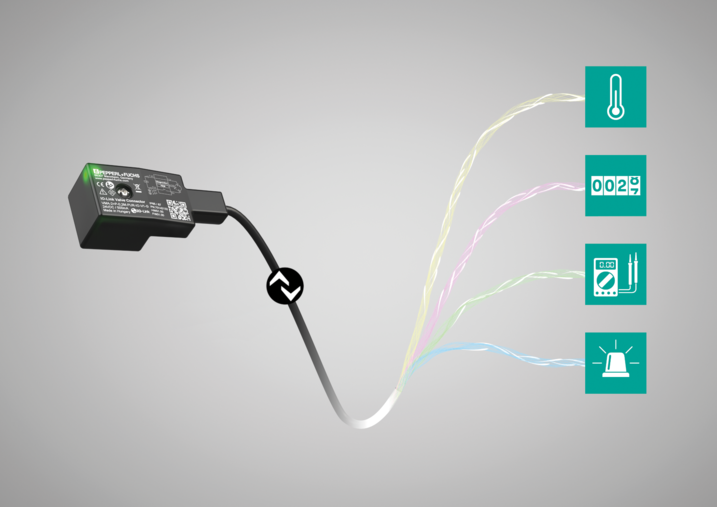
Standardized communication via IO-Link opens up numerous advantages for solenoid valves.
All process data is passed on to the controller or a cloud-based system via an IO-Link master—for example, via a device from the ICE* series. In this way, the valve connector provides all the data needed for condition monitoring and predictive maintenance. This solution, which is also ideal for retrofitting existing plants, turns any standard valve into a smart device that can be fully integrated into Industry 4.0 environments.
Longer Service Life Due to Power Save Mode
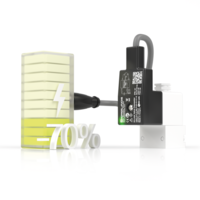
To further increase the service life of the valve, the valve connector can be operated in power save mode. By pulse width modulation (PWM), the output current can be controlled depending on the valve type. As a result, energy reductions of up to 70% can be achieved. This also lowers the temperature at the valve, eliminating the need to install cooling devices and significantly extending the service life of the valve.
Increased Convenience during Installation and Maintenance
The valve connector is supplied with a pre-assembled M12 connector. This allows it to be connected directly to the IO-Link master without having to assemble a cable on site. Since each valve connector can be individually named in the software, it is easy to assign the data to the respective connector or valve. Moreover, a programmable LED status indicator simplifies maintenance: the “Find me” function allows valves to be identified quickly and easily. The event-related programming of the LED means that the current status of the valve can be identified at first glance. In addition, all device settings are stored in the IO-Link master, eliminating the need for time-consuming parameterization when replacing a device.
Highlights of the IO-Link Valve Connector
- Increased plant availability: reliable condition monitoring due to various digital diagnostic data via IO-Link
- Individual control of the output current in PWM mode enables energy reduction of up to 70%
- Short response times in the event of maintenance due to configurable alarm function when defined limit values are exceeded
- Event-related LED for fast status display and identification of faulty valves directly in the plant
- Complete solution from a single source—extensive IO-Link portfolio for any requirement
With the R202 series, Pepperl+Fuchs offers a new portfolio of photoelectric sensors in cubic design. The sensors with a red light LED and a simple switching function with two switching outputs are focused on basic functions. This leads not only to particular cost efficiency, but also to simple product selection. Five function principles are available in a standardized housing design: Thru-beam sensor, retroreflective sensor, retroreflective sensor for clear-object detection, diffuse mode sensor, and diffuse mode sensor with background suppression. The variant for clear-object detection as well as simple and robust mounting make the series the first choice for material handling applications.
Designed for Material Handling
The R202 series was developed with the special requirements of the material handling industry in mind. In pallet conveyor technology, for example, foil-wrapped pallets often have to be detected. With their reflective surfaces, they represent a challenge for the sensor technology used. The retroreflective sensor for clear-object detection was designed for such demanding tasks: It operates without dead band and is optimized for detecting shiny, reflective objects.
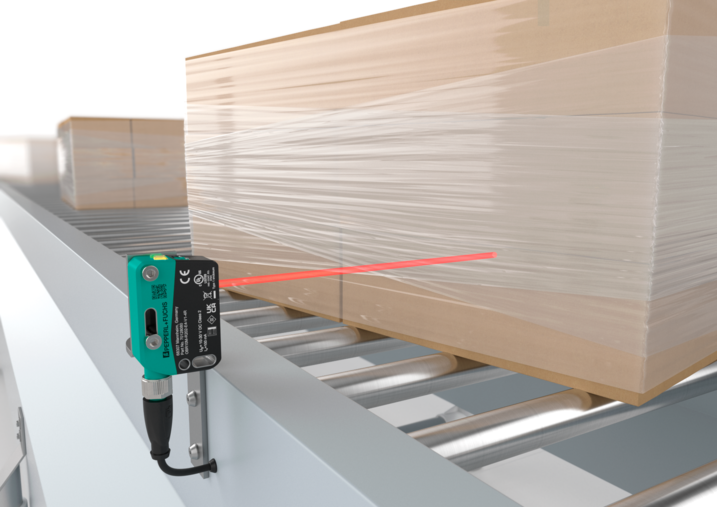
The variant for clear-object detection reliably detects foil-wrapped pallets.
In addition, the sensors of the R202 series have integrated solid metal bushings. With their high mechanical stability, they allow higher tightening torques compared to direct mounting on the plastic housing. This ensures reliable and stable mounting over the long term—for robust use in material handling applications.
Flexible Mounting, Compact AC Variants
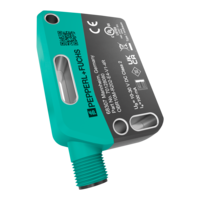
The R202 combines standard holes and slots.
The combination of standard holes and slots offers flexible mounting options, both horizontally and vertically. Due to the standard holes, the sensors can be combined with all commercially available mounting brackets. For example, the R202 series uses the same mounting system as the R201 series from Pepperl+Fuchs. If both series are used in one plant, the same mounting accessories can be used, which makes installation particularly quick and simple.
In addition, the R202 series is also ideal for applications where AC voltage is required. All variants include an AC/DC power supply with a voltage of 24–240 V if required. This makes the sensors suitable for a wide range of applications, for example in building and entrance automation or in the US market. Compared to conventional devices, the AC variants of the R202 series are also significantly smaller in size. This means that they can be easily integrated even in confined spaces.
Highlights of the R202 Series
- Optimized series for easy product selection: Essential functions in a cost-effective design
- Reliable detection of foil-wrapped objects with variant for clear-object detection
- Robust use in warehouse and conveyor technology through integrated metal bushings
- Standard design with numerous holes for mounting flexibility
- Space-saving AC variants for applications where AC voltage is required